LaTeX templates and examples — Two-column
Recent
Let's take a look into the dynamic history of the Noscuk valley and its people.
Las bases de datos relacionales han sido las herramientas por excelencia para el almacenamiento de la información en los sistemas informáticos. No obstante, las bases de datos NoSQL, como tendencia, han venido ganando espacio especialmente por la escalabilidad y velocidad en sus tiempos de respuestas. PostgreSQL ha incorporado algunas características de tipo NoSQL, como el almacenamiento efímero y el manejo de datos JSON; características que pueden aprovecharse para realizar acciones desde el gestor dándole mayor potencia. El objetivo de este artículo es evaluar, mediante toda la documentación encontrada, el comportamiento de las características NoSQL de PostgreSQL frente a un gestor NoSQL, comparandola con MongoDB, respecto a los tiempos de respuestas y dar a conocer las ventajas de uno con respecto al otro. Palabras Claves: Características NoSQL en PostgreSQL, MongoDB, PostgreSQL
El presente documento es una guía amigable de LaTeX para la redacción de protocolos de investigación con algunas sugerencias de como debe ser presentada y redactada la propuesta. Esta guía actualmente es utilizada por el departamento posgrado de ingeniería electrónica del Instituto Tecnológico de Morelia.
Recent work on information extraction has suggested that fast, interactive tools can be highly effective; however, creating a usable system is challenging, and few publically available tools exist. In this paper we present IKE, a new extraction tool that performs fast, interactive bootstrapping to develop high-quality extraction patterns for targeted relations, and provides novel solutions to these usability concerns. In particular, it uses a novel query language that is expressive, easy to understand, and fast to execute - essential requirements for a practical system - and is the first interactive extraction tool to seamlessly integrate symbolic and distributional methods for search. An initial evaluation suggests that relation tables can be populated substantially faster than by manual pattern authoring or using fully automated tools, while retaining accuracy, an important step towards practical knowledge-base construction.
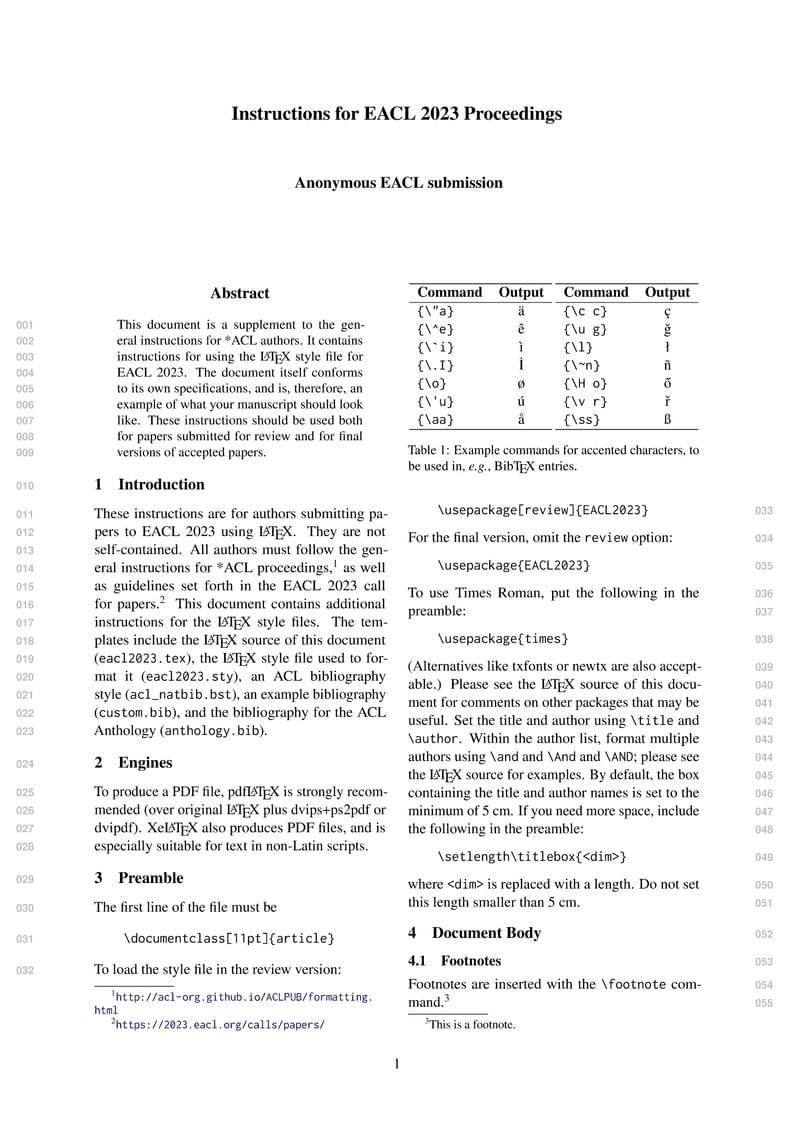
Paper template for EACL 2023, the 17th Conference of the European Chapter of the Association for Computational Linguistics https://2023.eacl.org/
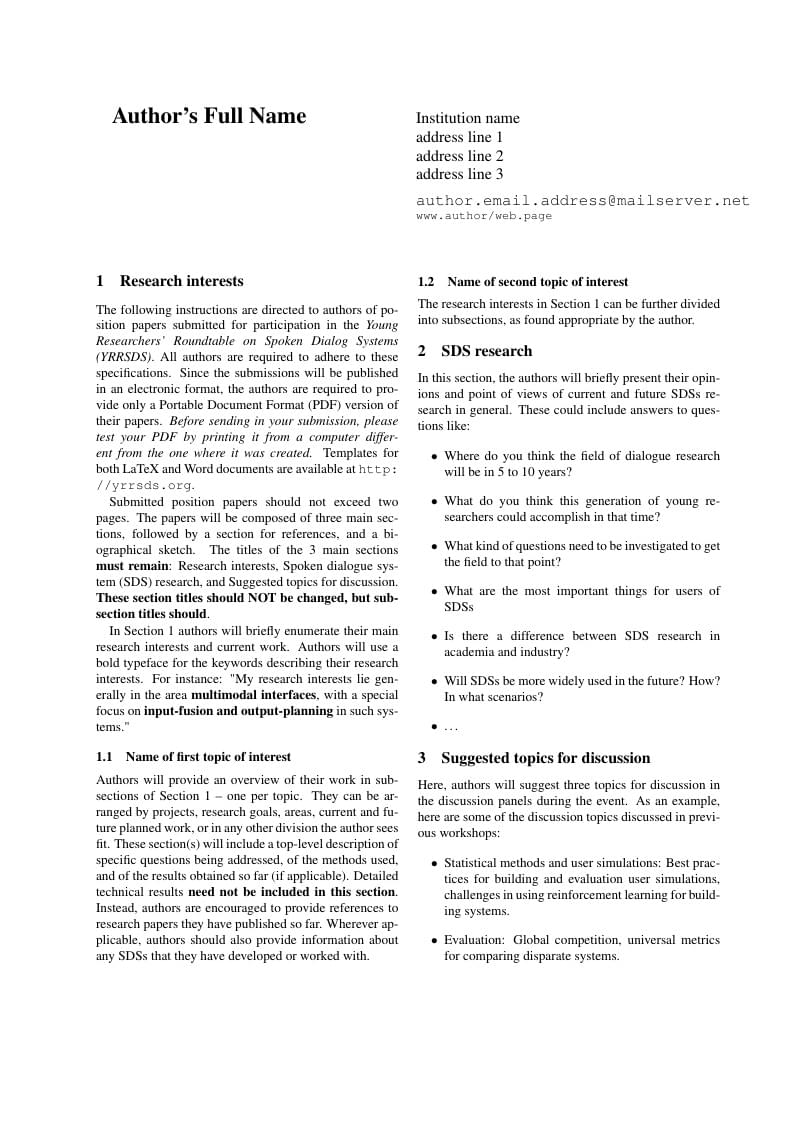
Submission template for the Young Researchers’ Roundtable on Spoken Dialog Systems (YRRSDS 2020)
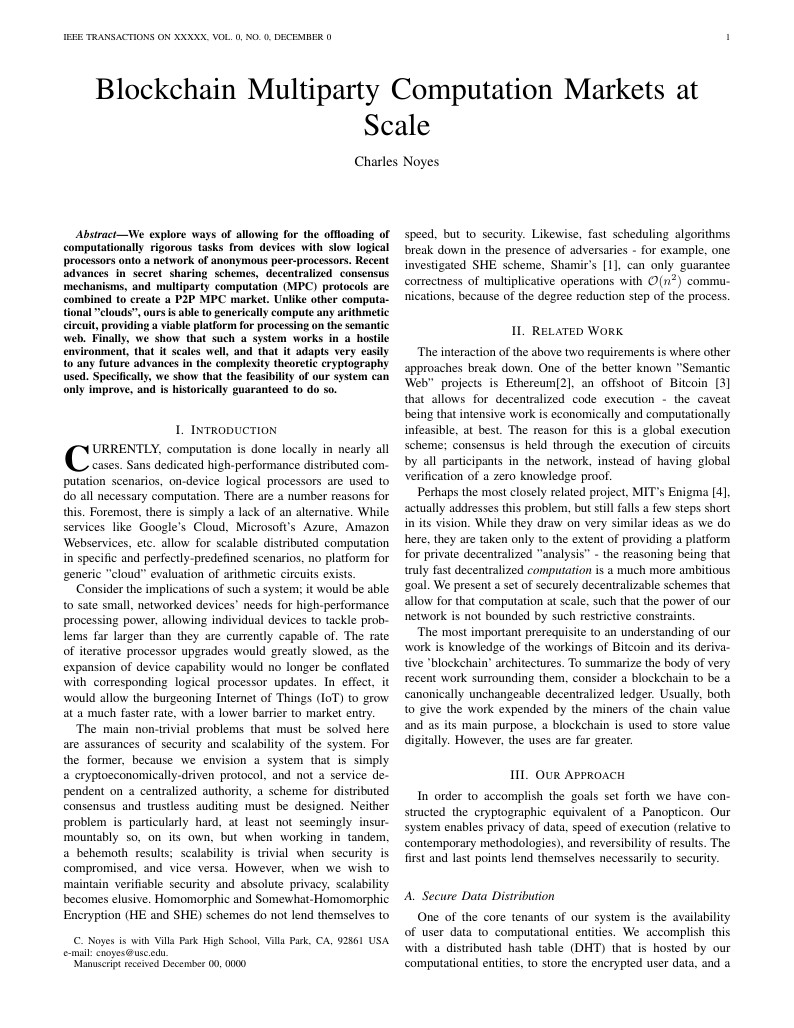
We explore ways of allowing for the offloading of computationally rigorous tasks from devices with slow logical processors onto a network of anonymous peer-processors. Recent advances in secret sharing schemes, decentralized consensus mechanisms, and multiparty computation (MPC) protocols are combined to create a P2P MPC market. Unlike other computational "clouds", ours is able to generically compute any arithmetic circuit, providing a viable platform for processing on the semantic web. Finally, we show that such a system works in a hostile environment, that it scales well, and that it adapts very easily to any future advances in the complexity theoretic cryptography used. Specifically, we show that the feasibility of our system can only improve, and is historically guaranteed to do so.
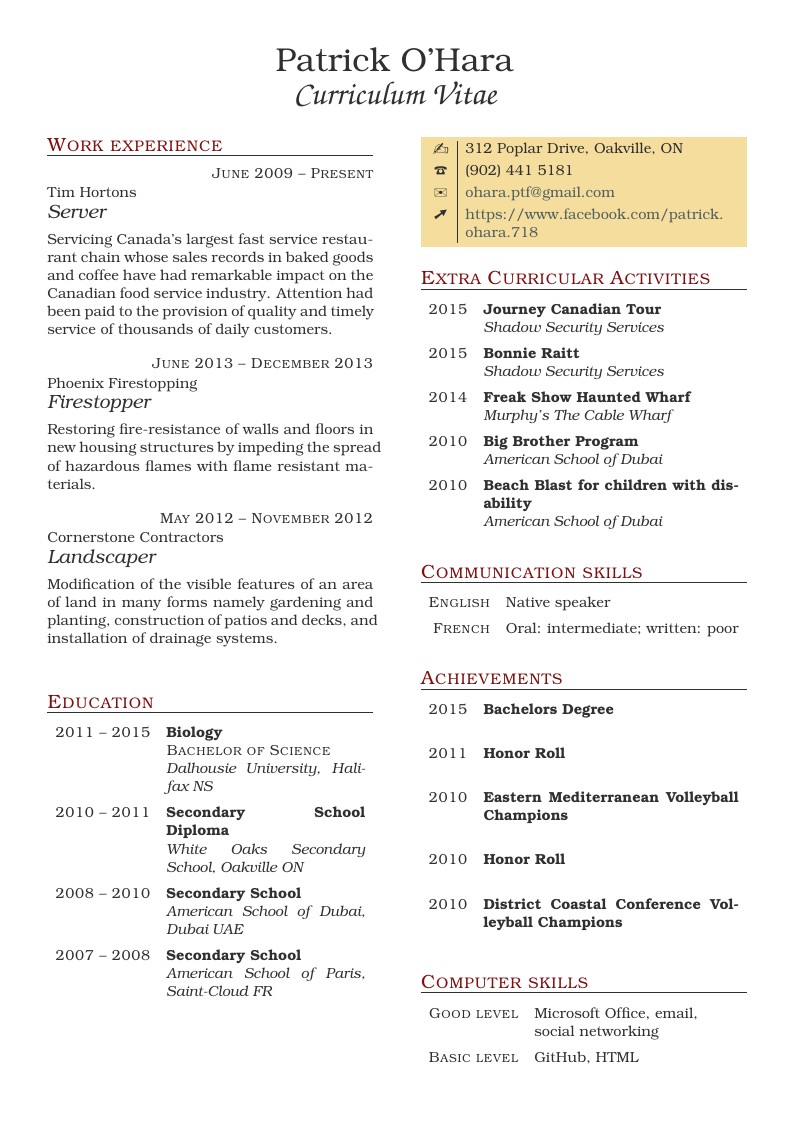
tccv (two columns curriculum vitae) is a LaTeX class inspired by the template found at latextemplates.com by Alessandro Plasmati. Create by Nicola Fontana, the original files can be downloaded from: http://dev.entidi.com/p/tccv/
This paper describes the use of the LaTeX qjrms4.cls class file for setting papers for the Quarterly Journal of the Royal Meteorological Society
\begin
Discover why over 30 million people worldwide trust Overleaf with their work.