Community articles — University
Recent
Este trabajo presenta la aplicación de un conjunto de articulos con propias teorías de los robots manipuladores y el modelamiento de pinzas. Para ello el brazo humano se modela como un robot manipulador redundante. En particular se aplica el concepto de índices de desempeño para predecir posturas óptimas del brazo durante la realización de tareas. En el estudio se incluyen tanto estructuras estáticas, como tambien los analisis de estabilidad del brazo y los materiales para su respectiva realizacion. This work presents the application of a set of articles with the own theories of the manipulative robots and the modeling of tweezers. For this, the bearing is modeled as a redundant manipulator robot. In particular, the concept of performance indices is applied to predict the optimal postures of the task during the performance of tasks. The study includes both static structures, as well as safety management analyzes and materials for their respective realization.
In Email Analytics, our main focus on criminal and civil investigation from large email dataset. It is very difficult to deal with challenging task for investigator due to large size of email dataset. This paper offer an interactive email analytics various to current and manually intensive technique is used for search evidence from large email dataset. In investigation process, many emails are irrelevant to the investigation so it will force investigator to search carefully through email in order to find relevant emails manually. This process is very costly in terms of money and times. To help to investigation process. We combine Elasticsearch, Logstash and Kibana for data storing, data preprocessing, data visualization and data analytics and displaying results. In this process reduce the number of email which are irrelevant for investigation. It shows the relationship between them and also analyzing the email corpus based on topic relation using text mining.
This Project posits elementary analogies of existing Probabilistic and Machine Learning models that have been used to find solutions to the problem of the Structural Segmentation of Musical audio. I have tried to use the idea that the chord of a given beat or frame of a song is an analogous representation of the states generated by trained Hidden Markov Models in generating feature vectors for the aforementioned problem; and that the knowledge of the temporal boundaries within which, a group of frames lie, can be used as constraints in creating the feature vectors that are eventually clustered to identify the pattern in which the various segments of a song repeat.
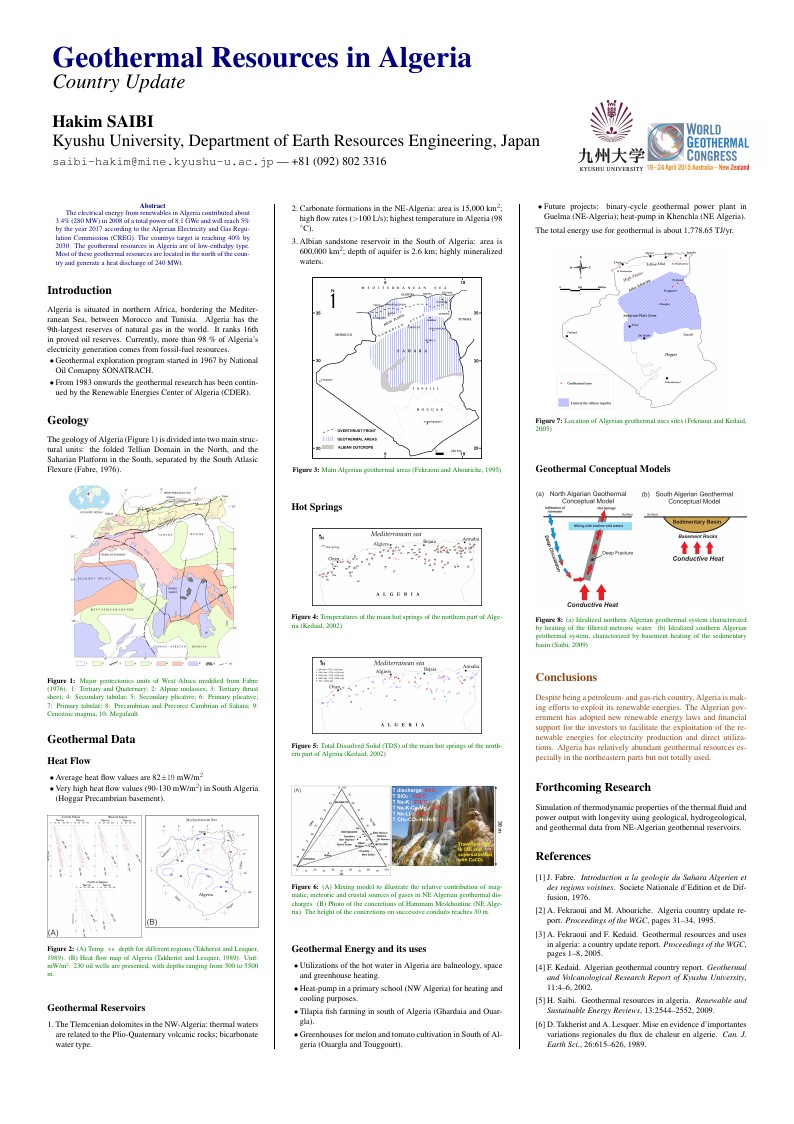
The electrical energy from renewables in Algeria contributed about 3.4\% (280 MW) in 2008 of a total power of 8.1 GWe and will reach 5\% by the year 2017 according to the Algerian Electricity and Gas Regulation Commission (CREG). The country’s target is reaching 40\% by 2030. The geothermal resources in Algeria are of low-enthalpy type. Most of these geothermal resources are located in the north of the country and generate a heat discharge of 240 MWt.
Articulo Colisionador de Particulas

The usage of software has grown as computers become popular. There have emerged, both in academia and in the market, technological solutions for several areas, among them education. On the other hand, classroom teaching and learning continues to suffer from classical educational problems such as lack of student and teacher motivation and lack of clear educational goals. And although software supports learning across a range of disciplines and ages, children's audiences, especially in mathematics, have been little contemplated with the benefits that technological solutions can bring. Therefore, the use of pedagogical approaches, such as Bloom's Taxonomy and Formative Assessments, together with gamification techniques, such as Octalysis, can be used to develop a technological solution that contemplates this public. The present work aims to propose the development of a software to assist the teaching and learning of mathematics for children in the classroom.
Research about recommendation systems has increased due to the amount of information that it is available to individuals. In the music context these systems help the individual to filter and discover new songs according the individual's taste. Most of the business music companies use a recommendation system, based on the characteristics of a song listened by an individual, but a group recommendation system is still underexplored. For a shared environment when there is music, the songs selection will be more efficient if a group recommendation system is used. The goal of this project is to develop a music recommendation for a group that, is sharing the same environment, taking into consideration the context. For this reason, in this work we will employ the Spotify API to recover the data of playlists that were listened by an individual, collecting its preferences and adding them to the others individuals playlists.
abtex2-modelo-trabalho-academico.tex, v-1.9.2 laurocesar Copyright 2012-2014 by abnTeX2 group at http://abntex2.googlecode.com/ This work may be distributed and/or modified under the conditions of the LaTeX Project Public License, either version 1.3 of this license or (at your option) any later version. The latest version of this license is in http://www.latex-project.org/lppl.txt and version 1.3 or later is part of all distributions of LaTeX version 2005/12/01 or later. This work has the LPPL maintenance status `maintained'. The Current Maintainer of this work is the abnTeX2 team, led by Lauro César Araujo. Further information are available on http://abntex2.googlecode.com/ This work consists of the files abntex2-modelo-trabalho-academico.tex, abntex2-modelo-include-comandos and abntex2-modelo-references.bib
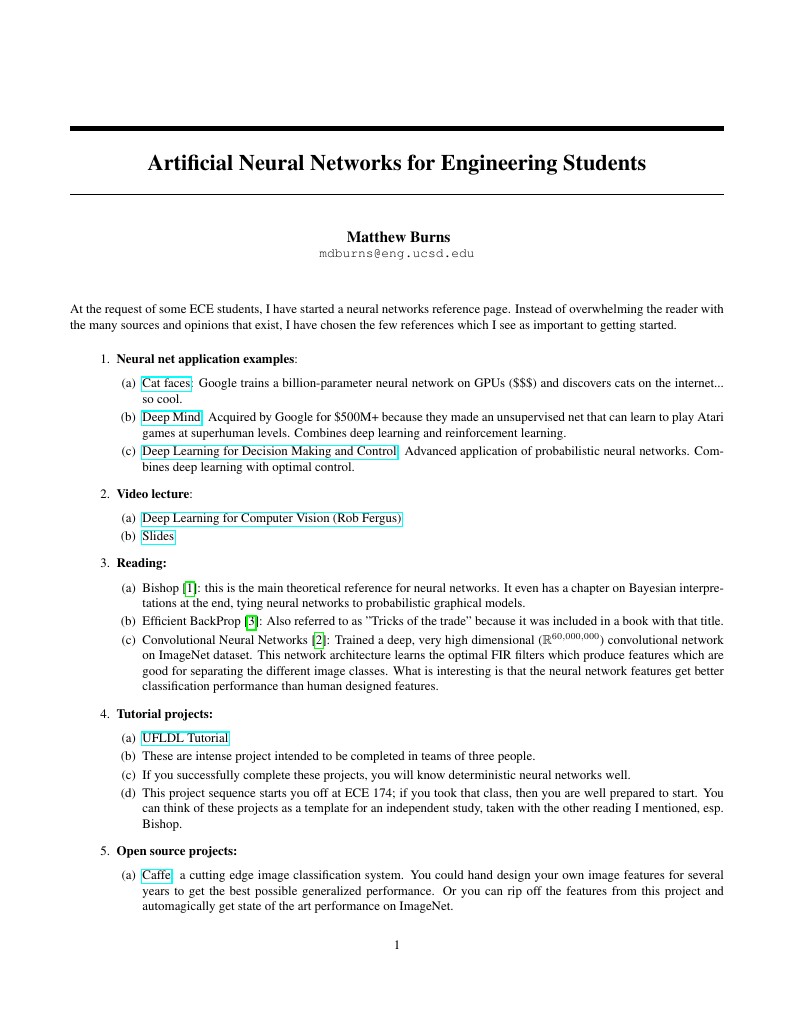
A primer to get UCSD ECE students into neural networks.
\begin
Discover why over 30 million people worldwide trust Overleaf with their work.